Friday, 20 December 2013

Painting Now - Tate Britain

The Painting Now exhibition is one that I enjoyed very much, showing the works of five contemporary artists. Starting with Tomma Abts, the paintings are neither figurative nor abstract but are more concerned with showing the process of the artist as none of the pieces are planned beforehand and result simply by instinct and letting the paint be the guide. By layering and making marks, Abts creates pieces that explore depth, volume and space. This was followed by Simon Ling who paints urban landscapes that appear to be crumpling and swaying. Ling, who often paints en plein air, captures the seemingly ordinary and overlooked parts of urban London, in what could be almost a kind of expressionist manner.
'Zebe'- Tomma Abts

Untitled- Simon Ling

The artists the stood out the most to me were Lucy Mckenzie and Gillian Carnegie. Mckenzie has a more conceptual approach compared to the other artists in the exhibition, which she combines her skills demonstrated through the tompe l'oeils and marble effect painting in 'Loos House'. In her triptych 'Quodlibet XII, XXII and XX- have been subtitled Objectivism, Nazism and Fascism respectively, Mckenzie paints what seem to be proposals for interiors, pinned on a board with paint samples, marbling effects, architectural drawings and furniture pictures (with the odd copy of an Ayn Rand book of a leaflet about socialists. Mckenzie invites the viewer to explore how a person's ideologies and character can be identified through their houses/interiors, how they are seen on the surface, through their fashion statements, their brands as well as their interiors. One might question Mckenzie's role in the exhibition because she is not a 'painter' in the sense that it is the ideas in the her work that matter rather than the material itself. However, she is still incredibly skilled in her craft and revives trompe l'oeils which have not been seen in contemporary art in a very long time. Gillian Carnegie is also a highly accomplished painter who's sleek, glossy, monochrome paintings are strangely geometric. One of her works that I found to be most intriguing depicts a group of houses, painted in the same slightly dull, monochrome palette, with a kind of glaze as if seen through a thick layer of fog. It's almost dreamlike- both heavy and weightless at the same time.

'Nazism' - Lucy Mckenzie

Gillian Carnegie's depiction of the Holly Lodge Estate

Jake and Dinos Chapman's 'Come and See'

Gory, gruesome and carnivalesque- those are the words I'd use to describe the Chapman's 'Come and See' exhibition at the Serpentine Sackler...

They imagine a horrific vision of the future, where Nazi soldiers, zombie like creatures and multi-headed mutants and Ronald McDonald (the victim in some instances and the abuser in others) all torture one another for all of eternity as depicted in 'Hell' and 'The Sum of All Evil'. These dioramas are both large and intricately, every figure is meticulously detailed as they stand frozen in a portrayal of their suffering, and upon closer inspection, doing rather shocking things to one another. Although I personally find that the message behind these two works, if there even is one definitive message, their work focuses on the themes of death, morality, consumerism and corruption.


The ideas of death can also be found in the traditional portraits that hang in the gallery, appropriated by the artists to make the flesh look rotten and decaying, the eyeballs in one painting appearing to be dark and terrifying as they bulge out. The series is titled 'One day you will no longer be loved' and for me, there is no horror in these paintings, only a kind of sadness as the viewer is reminded of the impermanence of beauty, love and life.

I found that although the larger pieces such as 'Hell' were stunning and shocking and brilliant, the true essence of the ideas and slightly childish and humorous approach to very serious issues lay in the smaller pieces such as the mini cardboard sculptures or the watercolour, pencil and pen drawings and etchings, illustrated strange and gruesome scenarios of monsters and unknown creatures emerging from the shadows and wreaking havoc. In several of these smaller works, the artists paint on pages from books, the text from which has either been altered or is written entirely by themselves as it is incoherent and ominous. 


Lastly, one cannot speak of this exhibition without mentioning the rainbow socks clad Ku Klux men dotted around the gallery space, each one complete with white robes with a smiley face, a pointed hat, rainbow socks and sandals, staring intently at the art work. At first their presence is shocking and unexpected (the ever staring figures was quite unnerving) but soon I grew oddly accustomed to seeing them around. Perhaps they are representations of the Chapman's audience? Although I fail to understand why they would refer to their audience as white supremacists. Overall, I found the exhibition to be shocking and strange yet interesting, leaving me with questions about the cynical, nightmarish impression of violence and inhumane world that the Chapman's leave behind.


Thursday, 12 December 2013

Animation for 'Bodies, Cities, Time, Borders'

I chose to explore 'bodies' and 'time', focusing on what happens to the body and soul over time and after death. I was inspired by the following poems: 

A verse from Walt Whitman's 'Song of Myself': 

'I bequeathe myself to the dirt to grow from the grass I love,
  if you want me again, look for me under your boot-soles.'

and Mary Elizabeth Frye's 'Do not stand at my grave and weep':

Do not stand at my grave and weep,
I am not there; I do not sleep.
I am a thousand winds that blow,
I am the diamond glints on snow,
I am the sunlight on ripened grain,
I am the gentle autumn rain.
When you awaken in the morning’s hush
I am the swift uplifting rush
Of quiet birds in circled flight.
I am the soft stars that shine at night.
Do not stand at my grave and cry,
I am not here; I did not die.

Following this theme of death only being the gateway to a different life, I wished to portray the idea that though the body does not remain, the soul may still do; surrendering itself to where it came from, becoming a part of the life that surrounds us.

This is the short animation that I made in response to these ideas..


Flight- One Day Project

For a short one day project titled 'Flight' we created a book sculpture. Our element of 'flight' came from a flock of origami birds that were flying out of a books...


Making and Drawing Workshop

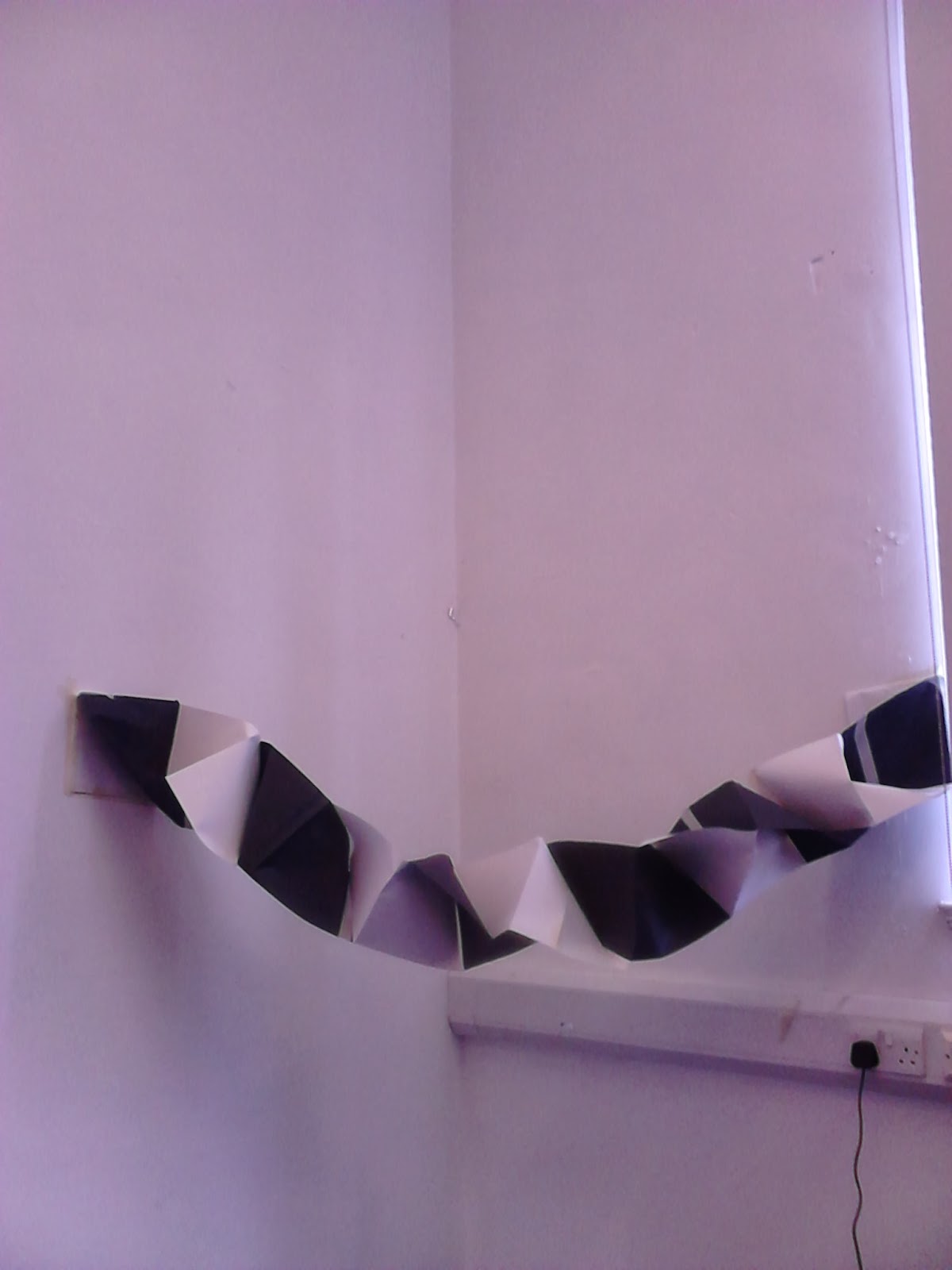
After choosing three words from a list, ours being 'fold', 'suspend' and 'light', we were asked to create sculptures using any of the materials found in the room. These are the results:


Then we proceeded to draw our sculptures, as well as those made by other students, using different methods such as continuous line drawn, and drawing only in straight lines.


Monday, 28 October 2013

Transforming the Everyday - Final Piece

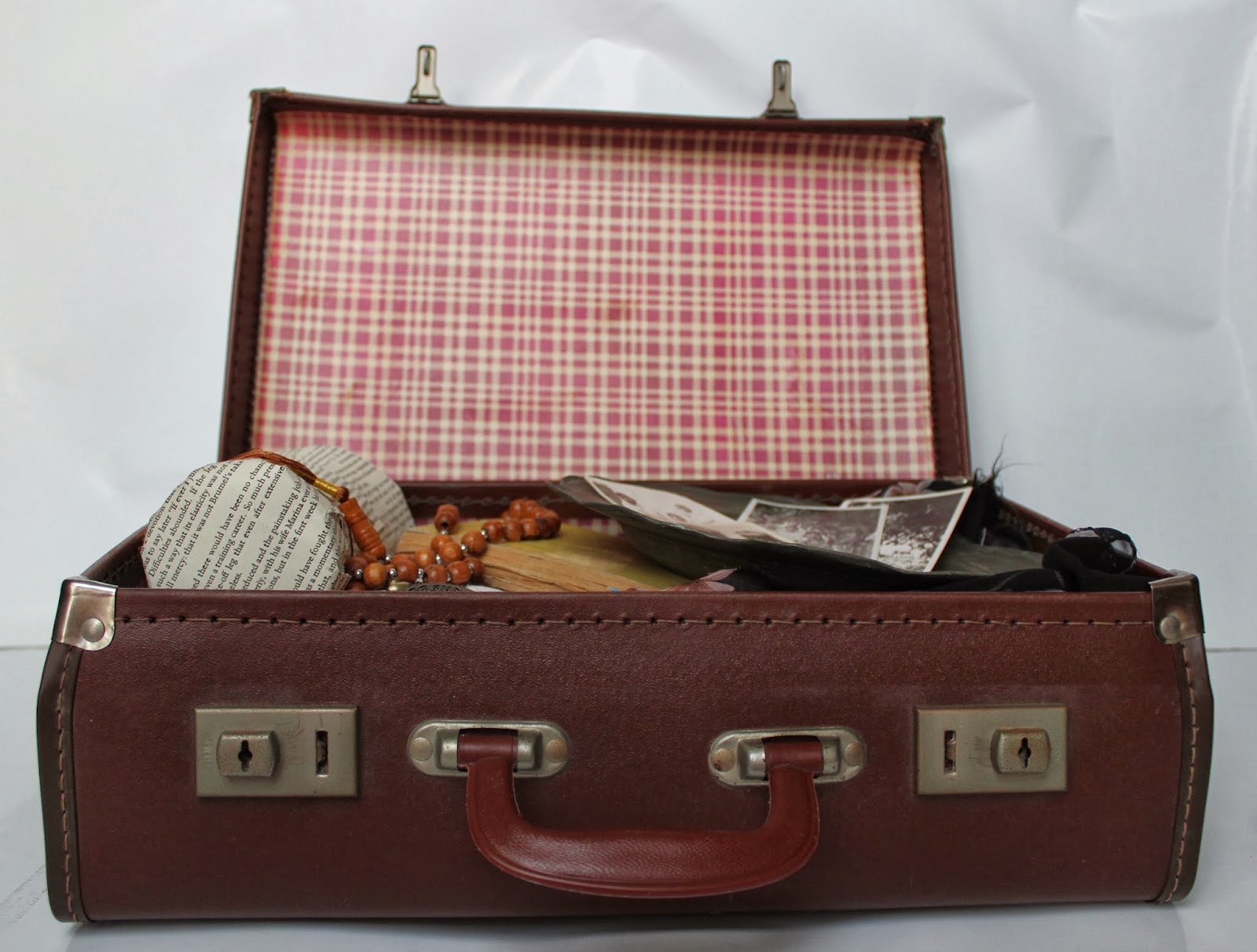
For my final project, I decided to use objects that were personal to me and I had a stronger connection to- my own magical objects. I chose to look at the story of my great grandmother, for whom I had great admiration as she, at a young age, crossed the borders of India to Pakistan during the 1947 partition. I was inspired not only by her bravery while going on this journey, the partition being the biggest migration of the 20th century during which thousands lost their lives, but also the strength it must have taken to leave behind her home and all she held dear to start a new life in a different place. Keeping in mind the stories that my great grandmother had told me countless times as a child, I decided to make a suitcase of my own, much like the ones from Willard Mental Asylum, documenting her journey from one country to the other, using the objects she brought with her to tell her story. Some of the objects I used were actually hers whilst others were those that I collected and imagined she would have brought with her. 

However, that didn't quite feel like enough. I wanted the objects to tell their story but I couldn't help but wonder if people who didn't know my great grandmother as I did would understand the story those objects were trying to tell. I wanted to physically bring those objects to life: If they could talk, what would they say? If we could follow their lives, where would they take us? To answer these questions, I decided to use my newly found interest in stop motion animation to create a short video following the life of one of the objects my great grandmother brought with her. The video, together with my suitcase, formed my final piece..

The animation follows the story of one of my great grandmother's possessions,
a steel glass, as it makes it way across borders with her. 


When presented, the suitcase was placed as seen above
Although unintentional, I like how the pages aren't quite covering the glass fully, the edges are lifted as if they are fraying. It gives the sense that the stories that it holds can't be contained as it is bursting with life. 

The glass, an actual possession of my great grandmother, has been covered in pages from the same
book as the one seen in the video to provide a stronger visual link between the suitcase and the video.
The spoons and plate are from my great grandmother's dowry, the pattern on which was said to be hand carved. I decided to put in the 'tasbih' (string of brown beads, the Islamic equivalent of rosary beads one might say) as religion was always a very important part of her life. 
These are some of the photographs I managed to collect from my relatives. My great grandparents can be seen in the first one, with my great grandmother in the middle in the second photograph. Adding the photos to the suitcase just makes the story more real and believable.


When presenting this piece, I played the video separately, with the suitcase placed on a table against the wall onto which the video was projected. I think the presentation could be more effective if the video was projected onto the opened suitcase, so that the story is in essence captured within the objects, physically and metaphorically. 

In Steven Connor's 'Parapharnalia', he says 'such things inhabit space, but are a kind of temporizing with it, a refracting of the white noon of now into a chronic rainbow of times, with their twilight tints and hues. Such things hum with hint and import because they are there without being fully present; to hand, but not exactly here-and-now.' This is the feeling I get when surrounded by these objects. They are haunting in a sense, but beautifully so. But it is I who feels like a ghost; as time passes, it is these objects that are still alive, long after the people to whom they belonged are not- they are unstopped clocks. 


Sunday, 27 October 2013

Magical Objects

In 'The Great Gatsby', Fitzgerald describes the objects that Gatsby associates some meaning with as 'enchanted objects', such as the green light with which he associates Daisy and the hope of being reunited with her. Once Gatsby is with her, the green light no longer holds the same significance; ''it was again a green light on a dock. His count of enchanted objects had diminished by one.'' These are the kinds of objects that I decided to look for; those that held meaning, had stories and thus became 'enchanted' because of our emotional investment in them..

Upon interviewing my neighbour, I found just what I was looking for. He had kept a collection of family relics and heirlooms; war medals, brocohes, wedding certificates, birth certificates etc, all kept locked and safe in an old, leather box.

The old, worn out leather adds to its feel of antiquity,
 proof of it's rich and eventful history..

I really like the frayed jute string that
holds the key and connects it to the box.  


 Each individual object found in the box had it's own life, a sense of being present but carrying with them an ancient weight, belonging an altogether different time..


Steven Connor, in his book 'Parapharnalia', describes objects like those above as 'magical objects'. He says 'We can do whatever we like to things, but magical things are things that we allow and expect to do things back to us. Magical things surpass themselves, in allowing us to increment and surpass ourselves with them.' Such is the nature of the objects I am interested in and wish to explore. However, for my project, I want to find objects that are 'magical' and 'enchanted' for me; something personal and meaningful. And I need not look very far...